The very gracious and insightful Edward Chun just posted a series of articles over at MTV Iggy (MTV's Asia culture site) about the state of Korean pop music. All are very interesting and fun. You can check out the main page here.
And best of all (from my selfish perspective), he happened to use me and POP GOES KOREA as a major source for several of his articles. Not only that, but Stone Bridge agreed to let Iggy use a few excerpts from my book, like this short chapter on the singer Rain, and this one on Shin Joong-hyun.
I appear mostly in Edward's introductory article, but if you read all his stuff, you'll hear my voice scattered here and there (along with a lot cooler people than myself, but I still happy to be included).
And there is this very cool interview with In Sooni (it has nothing to do with my book or me, but I thought it was great).
Just so you know that Edward is no slouch, I should let you know that he has a real music background (heck, he even has a Wikipedia page). So when he is talking about the musical elements of K-Pop or whatever, he is not just yammering on; in fact, he knows what he is talking about.
Anyhow... Edward, thanks much for the kind words and the great stories.

Showing posts with label Korean culture. Show all posts
Showing posts with label Korean culture. Show all posts
Monday, September 07, 2009

Sunday, February 22, 2009
Hip Korea on Discovery
Well, the big debut of HIP KOREA is nearly here. Monday night at 9pm on Discovery Channel across most of Asia will see the premiere of HIP KOREA -- SEOUL VIBES, a documentary about Jung Jihoon (aka, the pop star Rain) and modern Korean pop culture.
I mention this because HIP KOREA is the first documentary I have been involved with. It was made by the production company Bang Singapore, which has made oodles of documentaries for Discovery and the other top cable channels.
The theme of the program is somewhat similar to POP GOES KOREA, examining the life of a pop star to see how his life was shaped by a culture and how he in turn influences that culture. In fact, I briefly profiled Rain in my book (just a short sidebar, but hopefully people like it).
So when the president of Bang Singapore, Keiko Bang, told me that she wanted to examine Korean culture through some of its top stars, it seemed like a natural opportunity to collaborate.
You can catch the promos here:
The show premieres on Feb. 26 in Taiwan, and in May in Japan. And in the fall in Europe.
May will see part two of HIP KOREA, a look at Lee Byung-hun, which I think will balance nicely with the Rain episode.
I mention this because HIP KOREA is the first documentary I have been involved with. It was made by the production company Bang Singapore, which has made oodles of documentaries for Discovery and the other top cable channels.
The theme of the program is somewhat similar to POP GOES KOREA, examining the life of a pop star to see how his life was shaped by a culture and how he in turn influences that culture. In fact, I briefly profiled Rain in my book (just a short sidebar, but hopefully people like it).
So when the president of Bang Singapore, Keiko Bang, told me that she wanted to examine Korean culture through some of its top stars, it seemed like a natural opportunity to collaborate.
You can catch the promos here:
The show premieres on Feb. 26 in Taiwan, and in May in Japan. And in the fall in Europe.
May will see part two of HIP KOREA, a look at Lee Byung-hun, which I think will balance nicely with the Rain episode.
Tuesday, December 23, 2008
Discovering Hip Korea
Korea Herald (along with countless Korean language outlets and fan sites) is reporting that the Discovery Channel is going to air a couple of documentaries called HIP KOREA this spring. One will be about the singer Rain (Jung Ji-hoon) and is subtitled "Seoul Vibes," while the other is about Lee Byung-hun and is called "Seoul Savvy."
Actually, this was reported in the foreign press over two weeks ago.
As for what it all means, I will excuse myself from commenting for now. But I hope people really enjoy the shows.
Actually, this was reported in the foreign press over two weeks ago.
As for what it all means, I will excuse myself from commenting for now. But I hope people really enjoy the shows.
Saturday, August 16, 2008
Seoul Fringe Festival Kicks Off
Okay, this post is late, very sorry. But it is not too late to check out this year's Seoul Fringe Festival, taking place right now in Hongdae.

This is the 11th Seoul Fringe Festival, a two-week celebration of independent, underground and sometimes just plain weird art, music, theater and other cultural goodness. Do not expect to see many of Hongdae's biggest bands at Fringe. The whole point of the show is to give unestablished artists a chance to show off. They might be raw and unready (and they might not be any good), but I think it is good to shaking things up from time to time... especially in a place as hierarchical as Korea.
The festival takes place pretty much all over the area around Hongik University, with the bulk of events happening along the "meat street" area (the twisting road/park that runs just behind the LG Palace, KFC, and Soundholic).
You can download a map of Hongdae showing all the Fringe Festival locations from the front page of the English website (sorry, but it is a javascript link, so I cannot link directly to it).

This is the 11th Seoul Fringe Festival, a two-week celebration of independent, underground and sometimes just plain weird art, music, theater and other cultural goodness. Do not expect to see many of Hongdae's biggest bands at Fringe. The whole point of the show is to give unestablished artists a chance to show off. They might be raw and unready (and they might not be any good), but I think it is good to shaking things up from time to time... especially in a place as hierarchical as Korea.
The festival takes place pretty much all over the area around Hongik University, with the bulk of events happening along the "meat street" area (the twisting road/park that runs just behind the LG Palace, KFC, and Soundholic).
You can download a map of Hongdae showing all the Fringe Festival locations from the front page of the English website (sorry, but it is a javascript link, so I cannot link directly to it).
Monday, June 23, 2008
Is Rokon Off?
Just heard about an odd announcement on Facebook -- looks like the magazine Rokon is having a farewell party on June 27 at Sortino's in Itaewon. Does that mean Rokon is no more?
Seoul has several free English-language magazines -- ROKON, GROOVE, and ELOQUENCE (not to mention one not-so-free magazine, SEOUL). While Rokon was definitely the prettiest of the freebies, it was not exactly a fountain of music news or cultural insight. Probably for the best that the few people writing useful articles move over to the remaining mags and try to make something more substantial.
The history of English-language 'zines and publications in Korea is a sad but long one. The best way to learn about it is to pick up a copy of J. Scott Burgeson's book KOREA BUG, which has a great 70-page essay about English-language publications in Korea, from Ernest T. Bethell's KOREAN DAILY NEWS to Skunk Hell's BROKE IN SEOUL.
For an overview of more recent indie publications, like K-SCENE and ROKON, Scott has another essay here.
Seoul has several free English-language magazines -- ROKON, GROOVE, and ELOQUENCE (not to mention one not-so-free magazine, SEOUL). While Rokon was definitely the prettiest of the freebies, it was not exactly a fountain of music news or cultural insight. Probably for the best that the few people writing useful articles move over to the remaining mags and try to make something more substantial.
The history of English-language 'zines and publications in Korea is a sad but long one. The best way to learn about it is to pick up a copy of J. Scott Burgeson's book KOREA BUG, which has a great 70-page essay about English-language publications in Korea, from Ernest T. Bethell's KOREAN DAILY NEWS to Skunk Hell's BROKE IN SEOUL.
For an overview of more recent indie publications, like K-SCENE and ROKON, Scott has another essay here.
Saturday, June 02, 2007
Thursday, April 26, 2007
Random Notes - Vol. 2, No. 7
Tuesday, March 06, 2007
(If Free Use Is Wrong)
I Don't Want to Be Copyright
Kind of interesting, imho -- the Ministry of Culture and Tourism has opened a website full of items whose copyrights have expired, and so are available for free use. Literature, music, art, just oodles of interesting stuff. The Ministry claims over 10,000 works will be available at first, with more to come, although I have not tried counting. It is all in Korean, but even blind clicking can turn up some interesting artworks (try poking around this area).

As I have mentioned before, the Ministry of Culture is currently pushing "Han Culture" (traditional Korean culture) as a way of moving the Korean Wave to a second phase, beyond just pop culture. I am pretty ambivalent about this idea for many reasons... I mean, I like the idea of better presenting traditional Korean culture. But I have doubts about how receptive the world will be on a popular level to this campaign. And I am in general skeptical anytime governments get involved in culture.
Instead of creating a new campaign, I would be much happier if the government just cleaned up its existing palaces (get rid of the linoleum and mold and put in real traditional paper floors) and created interesting brochures and audio tours (written and performed by professionals... not some vice-minister's niece or whatever). Or give Ryu Seung-whan a few dollars to set his new violence fest in the Chosun Dynasty, that could be fun.
Sure, Korean culture has a lot of great stuff -- but so has Thai culture, and Mongolia, and Kenyan, and Maori, and... and... and....
Point being, if you want to raise your profile and become significant to the world, you need to present works that capture people's imaginations. You cannot just sit back and expect the world to come to you and love you.

As I have mentioned before, the Ministry of Culture is currently pushing "Han Culture" (traditional Korean culture) as a way of moving the Korean Wave to a second phase, beyond just pop culture. I am pretty ambivalent about this idea for many reasons... I mean, I like the idea of better presenting traditional Korean culture. But I have doubts about how receptive the world will be on a popular level to this campaign. And I am in general skeptical anytime governments get involved in culture.
Instead of creating a new campaign, I would be much happier if the government just cleaned up its existing palaces (get rid of the linoleum and mold and put in real traditional paper floors) and created interesting brochures and audio tours (written and performed by professionals... not some vice-minister's niece or whatever). Or give Ryu Seung-whan a few dollars to set his new violence fest in the Chosun Dynasty, that could be fun.
Sure, Korean culture has a lot of great stuff -- but so has Thai culture, and Mongolia, and Kenyan, and Maori, and... and... and....
Point being, if you want to raise your profile and become significant to the world, you need to present works that capture people's imaginations. You cannot just sit back and expect the world to come to you and love you.
Friday, January 12, 2007
Han Style
The Korean Ministry of Culture and Tourism just announced a new promotion called HAN STYLE, which focuses on Korean traditional culture. Han Style refers to six major aspects of Korean culture: Hangul (Korean writing), Hansik (Korean food), Hanbok (Korean clothing), Hanok (Korean houses), Hanji (Korean mulberry paper) and Hanguk Eumak (Korean music).
(A bit of the cheat on that last "Han", btw. "Eumak" is music, but since that lacks the "Han" thing, they called it "Hanguk Eumak", which is just "Korean music").

Anyhow, Ministry Kim Myung-gon has been talking about this for a while. When Minister Kim addressed the Seoul Foreign Correspondents Club in September to talk about the Ministry's huge aid package for the movie industry, he also spent a good while talking about Korean traditional culture.
He emphasized the need to develop and preserve traditional culture to keep the current success of the Korean entertainment industry strong. “Water without a source cannot flow far,” Kim said. “Likewise, if the foundation of the Korean Wave is weak, it will be little more than a passing fad.”
While I usually do not like government mucking about in the arts, this seems to me to be a fairly benign, even useful move for the MCT. Korean traditional culture is perceived as less "sexy" than much of its neighbors. I think a lot of that is because of how it is marketed these days. For example, the palaces in Seoul tend to be poorly maintained. (Linoleum floors? And moldy at that...). Tourist guides tend to be written in Korean for Koreans, then translated into English; as a result, they are mind-bogglingly dull and obscure. More stuff like JEWEL IN THE PALACE could be a big help... People are not going to love Korean culture because Korean culture is so innately super-cool-beautiful. Rather, people will take an interest in Korean traditional culture when that culture is a part of interesting, well-told stories and other artworks.
But I do wish the government and other Korean bigwigs would widen their idea of what "Korean culture" is. There is a whole world of cool stuff that happened in Korea between the end of the Joseon Dynasty and the 1990s, just as interesting and deserving of preservation and marketing as any gayageum or hanok.
(A bit of the cheat on that last "Han", btw. "Eumak" is music, but since that lacks the "Han" thing, they called it "Hanguk Eumak", which is just "Korean music").

Anyhow, Ministry Kim Myung-gon has been talking about this for a while. When Minister Kim addressed the Seoul Foreign Correspondents Club in September to talk about the Ministry's huge aid package for the movie industry, he also spent a good while talking about Korean traditional culture.
He emphasized the need to develop and preserve traditional culture to keep the current success of the Korean entertainment industry strong. “Water without a source cannot flow far,” Kim said. “Likewise, if the foundation of the Korean Wave is weak, it will be little more than a passing fad.”
While I usually do not like government mucking about in the arts, this seems to me to be a fairly benign, even useful move for the MCT. Korean traditional culture is perceived as less "sexy" than much of its neighbors. I think a lot of that is because of how it is marketed these days. For example, the palaces in Seoul tend to be poorly maintained. (Linoleum floors? And moldy at that...). Tourist guides tend to be written in Korean for Koreans, then translated into English; as a result, they are mind-bogglingly dull and obscure. More stuff like JEWEL IN THE PALACE could be a big help... People are not going to love Korean culture because Korean culture is so innately super-cool-beautiful. Rather, people will take an interest in Korean traditional culture when that culture is a part of interesting, well-told stories and other artworks.
But I do wish the government and other Korean bigwigs would widen their idea of what "Korean culture" is. There is a whole world of cool stuff that happened in Korea between the end of the Joseon Dynasty and the 1990s, just as interesting and deserving of preservation and marketing as any gayageum or hanok.
Tuesday, October 31, 2006
Ad-ing Fuel to the Fire
Given that Korean pop music is pretty dreadful, it is always kind of surprising to hear cool music coming from so many advertisements on TV and radio. Sure, there is a lot of pop and mainstream stuff like James Blunt (The Face Shop), Pink (Anycall) and Boa (Olympus). But there is also more interesting stuff like the Clash (LG Telecom), Kings of Convenience (Maxwell House) and The Killers (Shinwha Bank).
Sometimes, however, even cool music can be quite funny (like when LG's Chai Apartments use Magnetic Fields' "100,000 Fireflies", and you hear the line "It makes me want to kill myself"... I doubt that association was what the advertising company was aiming for).
Sometimes, I hear music that I cannot identify, but fortunately we have a couple of websites to help out: www.tvcf.co.kr and www.cfmusic.co.kr. Both sites have a wealth of information about the advertisements currently gracing the Korean airwaves. Unfortunately, you do need to register to have access to most of those sites, and the sites are only in Korean. But if you can dig up an ID and can handle the Korean on the sites, both are extremely useful and fun.
The one ad that has been really bugging me for the last couple of months was the recent Nike ads, featuring Korean and Japanese athletes, and the singer BoA (they made local versions for Korea and Japan, but BoA was in both). I thought the song was really catchy, but had the worst time trying to find out what it was. Googling did not help me out either.
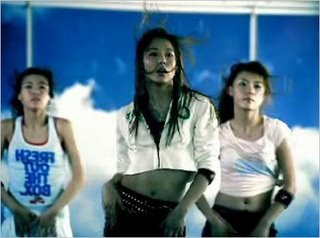
Actually, in this case, even CF-Music and TVCF did not help me enough. Only Naver could help. And even then, "Boa + Nike" did not help at all. But for some reason, "Nike + Boa" brought up the song name in the first hit -- Go Team. Good stuff.
Sometimes, however, even cool music can be quite funny (like when LG's Chai Apartments use Magnetic Fields' "100,000 Fireflies", and you hear the line "It makes me want to kill myself"... I doubt that association was what the advertising company was aiming for).
Sometimes, I hear music that I cannot identify, but fortunately we have a couple of websites to help out: www.tvcf.co.kr and www.cfmusic.co.kr. Both sites have a wealth of information about the advertisements currently gracing the Korean airwaves. Unfortunately, you do need to register to have access to most of those sites, and the sites are only in Korean. But if you can dig up an ID and can handle the Korean on the sites, both are extremely useful and fun.
The one ad that has been really bugging me for the last couple of months was the recent Nike ads, featuring Korean and Japanese athletes, and the singer BoA (they made local versions for Korea and Japan, but BoA was in both). I thought the song was really catchy, but had the worst time trying to find out what it was. Googling did not help me out either.
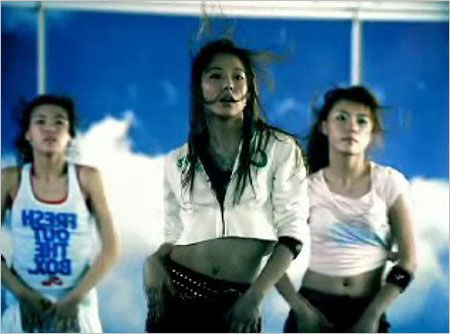
Actually, in this case, even CF-Music and TVCF did not help me enough. Only Naver could help. And even then, "Boa + Nike" did not help at all. But for some reason, "Nike + Boa" brought up the song name in the first hit -- Go Team. Good stuff.
Friday, October 27, 2006
Kim Il Passes Away
One of Korea's greatest professional wrestlers, Kim Il has passed away. Kim, who was better known in Japan as Kintaro Ohki, was the man most responsible for bringing pro graps from Japan over to Korea in the 1960s.
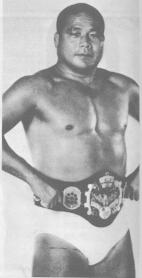
Trained by Rikidozan (Kim Shin-rak) in the late 1950s, Kim Il made his debut around the same time as Antonio Inoki (handing Inoki a loss in Inoki's debut match) and the Giant Baba, although he never acheived the heights of fame and popularity that either of those men did.
While professional wrestling was for many years extremely popular in Korea, it never quite reached the insane levels it did in Japan. And then in the early 1990s, when the local TV stations revealed how wrestling is "fake", the sport's popularity plummeted and never really recovered. Now, the WWE does okay when it swings by here once or twice a year, but there is very little local wrestling (despite what THE FOUL KING might have you believe).
I find it incredibly interesting now Korean audiences were never able to come to grips with the unreality of professional wrestling, in a way that never seemed to bother Japanese audiences (or how acknowledging pro wrestling's scripted side only made the WWE more popular in the late 1990s). Why does that bother some people so much? Who gets upset when they learn that Arnold Schwarzenegger is not really a robot or that the actors playing Romeo and Juliet are not really dead at the end of the play?
(This is not an exclusively Korean problem, of course. In the late Middle Ages/Early Modern era in Europe, when Morality Plays were first catching on, the Church objected to plays largely on the grounds that people would not be able to tell the difference between the story and reality. It is a concern that lives on, from THE LAST TEMPTATION OF CHRIST to THE DA VINCI CODE, from THE PRESIDENT'S LAST BANG to DEATH OF A PRESIDENT). (End of digression).
Professional wrestling, at its best, is extra-large pantomime... telling stories for thousands of people without using any words. Plays might feature a duel or sword fight or whatever to advance their stories, but pro wrestling is basically making the entire play out of the duel, stripping away the words. Sure, it can be vulgar and simplistic and have the air of the Roman Colosseum; but at its best, pro wrestling is fantastic theater.
Anyhow, a Youtube clip of Kim Il versus the Giant Baba, featuring plenty of Kim Il's famous headbutts. Sweet. Not so sweet, however, is how that Youtube match ends.
(PS: Sorry for the lack of posts, but in this case it is a good thing -- the book has been going well. And the book always trumps all over tasks.)

Trained by Rikidozan (Kim Shin-rak) in the late 1950s, Kim Il made his debut around the same time as Antonio Inoki (handing Inoki a loss in Inoki's debut match) and the Giant Baba, although he never acheived the heights of fame and popularity that either of those men did.
While professional wrestling was for many years extremely popular in Korea, it never quite reached the insane levels it did in Japan. And then in the early 1990s, when the local TV stations revealed how wrestling is "fake", the sport's popularity plummeted and never really recovered. Now, the WWE does okay when it swings by here once or twice a year, but there is very little local wrestling (despite what THE FOUL KING might have you believe).
I find it incredibly interesting now Korean audiences were never able to come to grips with the unreality of professional wrestling, in a way that never seemed to bother Japanese audiences (or how acknowledging pro wrestling's scripted side only made the WWE more popular in the late 1990s). Why does that bother some people so much? Who gets upset when they learn that Arnold Schwarzenegger is not really a robot or that the actors playing Romeo and Juliet are not really dead at the end of the play?
(This is not an exclusively Korean problem, of course. In the late Middle Ages/Early Modern era in Europe, when Morality Plays were first catching on, the Church objected to plays largely on the grounds that people would not be able to tell the difference between the story and reality. It is a concern that lives on, from THE LAST TEMPTATION OF CHRIST to THE DA VINCI CODE, from THE PRESIDENT'S LAST BANG to DEATH OF A PRESIDENT). (End of digression).
Professional wrestling, at its best, is extra-large pantomime... telling stories for thousands of people without using any words. Plays might feature a duel or sword fight or whatever to advance their stories, but pro wrestling is basically making the entire play out of the duel, stripping away the words. Sure, it can be vulgar and simplistic and have the air of the Roman Colosseum; but at its best, pro wrestling is fantastic theater.
Anyhow, a Youtube clip of Kim Il versus the Giant Baba, featuring plenty of Kim Il's famous headbutts. Sweet. Not so sweet, however, is how that Youtube match ends.
(PS: Sorry for the lack of posts, but in this case it is a good thing -- the book has been going well. And the book always trumps all over tasks.)
Thursday, September 28, 2006
Chuseok Is Coming...
Well, it looks like Chuseok (Korea's fall harvest festival) is going to be rather unusual this year. Since it is a holiday determined by the lunar calendar, it moves around each year, and this year it falls on Oct. 5-7. But Oct. 3 is Korea's National Foundation Day, to celebrate the founding of Korea by Dangun, the son of a god and a bear-woman, in 2333 BC (could have happened).
Anyhow, with Tuesday, Thursday and Friday already holidays, a good chunk of Korea is taking Monday and Wednesday off, too, and basically having a big vacation from Sept. 29 to Oct. 8. A nice eight or nine days off.
The reason I mention this is that Chuseok is also usually the biggest movie-going season in Korea. And they do not just go to any old movie -- usually this is one of the strongest seasons for local movies. Last year, when Chuseok was a more normal five days, 3.5 million people went to the movies (assuming no one went more than once). With a big 10 days off, the movie industry is practically giddy at the thought of how many tickets they might be able to sell. 10 million? 11 million? 12? Considering that Korea is on track to sell around 160 million tickets this year, conceivably around 8% of the year's box office could be decided over this 10-day stretch.
Which is why so many movies are coming out right now. You have RADIO STAR, the new movie by Lee Joon-ik (the guy who made THE KING AND THE CLOWN, the surprise hit of last winter which was until recently the most successful Korean film of all time). This story, starring two of the biggest names from the 1990s, Park Joong-hoon and Ahn Sung-gi, about a washed up rock star becoming a radio deejay out in the countryside, seemed pretty dubious to me. A real retro, Chungmuro story, the kind of thing that the Korean film industry would have made 10 years ago.

However, the film has been getting great buzz from its preview screenings. So who knows?
Another big film will be WAR OF FLOWERS (which I think CJ Entertainment has renamed, but I cannot find the new name, if it exists), a crime-noir thriller sort of thing about some card sharks. WAR OF FLOWERS is based on a popular newspaper comic strip from the 1990s, and it is directed by Choi Dong-hoon, the guy behind THE BIG SWINDLE, a film that did well among critics, even though it kind of flailed at the box office.
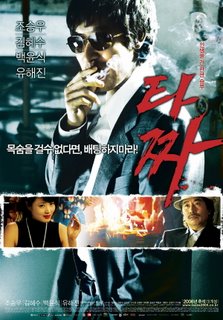
WAR OF FLOWERS is getting pretty good buzz, but more importantly, it is being distributed by CJ Entertainment. Why is that important? Because with so many films coming out right now, getting access to screens is incredibly competitive. And since CJE runs the CJ CGV, the biggest multiplex chain in Korea, that gives their movies an instant leg up.
Other films? Well, MARRYING THE MAFIA 3 and MAUNDY THURSDAY are both still doing well, and will fight to keep their screens. And there is some sort of Kim Jung-eun "comedy" called JAL SALABOSE ("Let's Get Better," a very famous song from the Saemaeul movement in the 1970s). There is also THE FOX FAMILY, a comedy-horror based on Korea's folktale of the nine-tailed foxes.
Buena Vista Korea is distributing the new Jackie Chan film ROB-B-HOOD. While I am not a huge fan of Mr. Chan's recent films, nor of films revolving around cute babies, Jackie often does okay in Korea, and BV has got around 165 screens for the film, so who knows, it could do well (I'm told they are tracking 400,000 or so over this opening weekend).
And believe it or not, there is more. Altogether, around 11 movies make their debuts over this weekend.
Anyhow, with Tuesday, Thursday and Friday already holidays, a good chunk of Korea is taking Monday and Wednesday off, too, and basically having a big vacation from Sept. 29 to Oct. 8. A nice eight or nine days off.
The reason I mention this is that Chuseok is also usually the biggest movie-going season in Korea. And they do not just go to any old movie -- usually this is one of the strongest seasons for local movies. Last year, when Chuseok was a more normal five days, 3.5 million people went to the movies (assuming no one went more than once). With a big 10 days off, the movie industry is practically giddy at the thought of how many tickets they might be able to sell. 10 million? 11 million? 12? Considering that Korea is on track to sell around 160 million tickets this year, conceivably around 8% of the year's box office could be decided over this 10-day stretch.
Which is why so many movies are coming out right now. You have RADIO STAR, the new movie by Lee Joon-ik (the guy who made THE KING AND THE CLOWN, the surprise hit of last winter which was until recently the most successful Korean film of all time). This story, starring two of the biggest names from the 1990s, Park Joong-hoon and Ahn Sung-gi, about a washed up rock star becoming a radio deejay out in the countryside, seemed pretty dubious to me. A real retro, Chungmuro story, the kind of thing that the Korean film industry would have made 10 years ago.

However, the film has been getting great buzz from its preview screenings. So who knows?
Another big film will be WAR OF FLOWERS (which I think CJ Entertainment has renamed, but I cannot find the new name, if it exists), a crime-noir thriller sort of thing about some card sharks. WAR OF FLOWERS is based on a popular newspaper comic strip from the 1990s, and it is directed by Choi Dong-hoon, the guy behind THE BIG SWINDLE, a film that did well among critics, even though it kind of flailed at the box office.
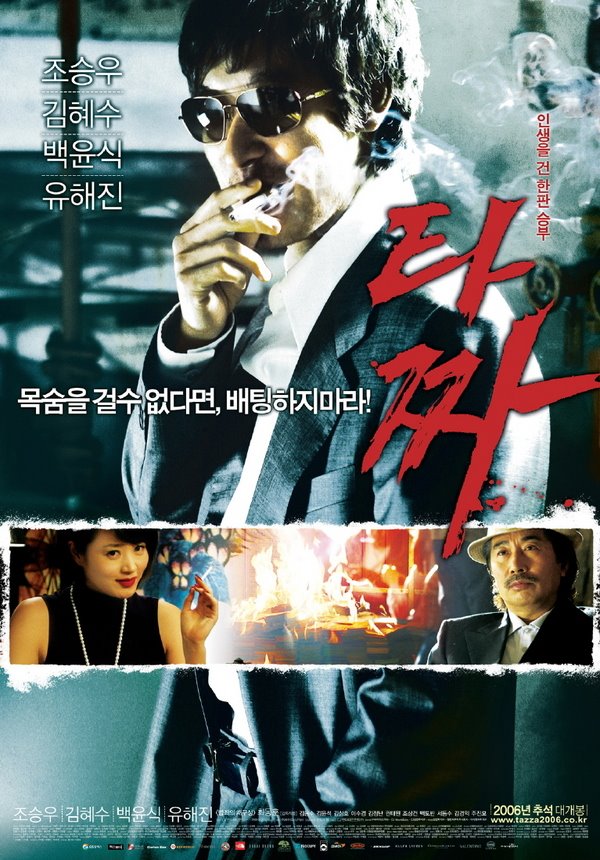
WAR OF FLOWERS is getting pretty good buzz, but more importantly, it is being distributed by CJ Entertainment. Why is that important? Because with so many films coming out right now, getting access to screens is incredibly competitive. And since CJE runs the CJ CGV, the biggest multiplex chain in Korea, that gives their movies an instant leg up.
Other films? Well, MARRYING THE MAFIA 3 and MAUNDY THURSDAY are both still doing well, and will fight to keep their screens. And there is some sort of Kim Jung-eun "comedy" called JAL SALABOSE ("Let's Get Better," a very famous song from the Saemaeul movement in the 1970s). There is also THE FOX FAMILY, a comedy-horror based on Korea's folktale of the nine-tailed foxes.
Buena Vista Korea is distributing the new Jackie Chan film ROB-B-HOOD. While I am not a huge fan of Mr. Chan's recent films, nor of films revolving around cute babies, Jackie often does okay in Korea, and BV has got around 165 screens for the film, so who knows, it could do well (I'm told they are tracking 400,000 or so over this opening weekend).
And believe it or not, there is more. Altogether, around 11 movies make their debuts over this weekend.
Subscribe to:
Posts (Atom)

 RSS
RSS
